
Local Massachusetts delivery


Preparing Your Home for Medical Equipment
Bringing medical equipment into a home often requires more than simply deciding where to put it.
A hospital bed needs enough room for the person using it and anyone providing care. A lift chair needs space to recline and move. A power wheelchair needs clear pathways and somewhere to charge. Ramps and stair lifts depend on the physical layout of the home.

Start With How the Person Will Actually Use the Home
Before measuring anything, think about the person's everyday routine.
Where will they sleep?
Which entrance will they use?
Where will they spend most of the day?
Which bathroom is easiest to access?
Will they need to move between floors?
Will they be using a wheelchair, walker, scooter, or other mobility device?
Will a family member or caregiver need room to assist them?
This is particularly important when someone is coming home after a hospital or rehabilitation stay. The goal isn't necessarily to prepare the entire house at once. It's to make the areas they'll rely on most workable for their current needs.
Walk the Path From the Door to the Equipment
One of the easiest things to overlook is how the equipment will actually get into the home.
A piece of equipment may fit perfectly in its final location but still need to pass through an entrance, hallway, doorway, or other tight area to get there.
Before delivery, look at the entire path:
Exterior entrance
Steps or thresholds
Doorways
Hallways
Corners
Stairways
Furniture
Rugs
Low-hanging objects
Clutter or other obstacles
Larger equipment may require measurements before delivery.
If you're unsure what needs to be measured, ask Prosperity Health. Depending on the equipment, we can tell you what information may be helpful before delivery is scheduled.
Prepare the Room
Once you've considered the delivery path, look at the equipment's final location.
Don't plan around the equipment's footprint alone.
There may also need to be room for:
Powered components to move

Preparing for a Hospital Bed
Hospital beds are among the larger pieces of medical equipment commonly brought into a home.
Before delivery, decide where the bed will go and clear the room as much as reasonably necessary.
Consider:
The delivery path
Make sure there is a clear route from the entrance to the bedroom or other intended location.
Room dimensions
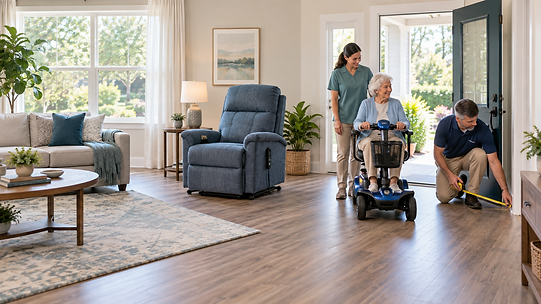
Preparing for a Lift Chair
A lift chair needs more room than an ordinary stationary chair because it changes position.
Consider:
Space behind and around the chair
Nearby walls and furniture
Access to an appropriate electrical outlet
The path the chair will take into the room
How the person will approach and leave the chair
Preparing for Oxygen & CPAP Equipment
Respiratory equipment requires attention to both practical setup and equipment-specific safety requirements.
For CPAP or BiPAP equipment, consider where the machine will sit, access to electrical power, and room for tubing and applicable accessories.
For home oxygen equipment, follow all equipment instructions regarding placement, storage, and use. Oxygen should be kept away from smoking, open flames, sparks, and other ignition sources.
Don't change prescribed oxygen flow rates, pressure settings, or other therapy settings without guidance from the appropriate healthcare professional.
Preparing for a Wheelchair Ramp
Ramp planning begins outside the home.
The right configuration depends on the entrance and surrounding property—not simply the fact that someone uses a wheelchair.
Important considerations can include:
Number and height of steps
Overall rise
Available space
Door and threshold
Porches or landings
Walkways
Direction of approach
Mobility device being used
Whether the need is temporary or long term
Photos and measurements may help determine what type of ramp solution should be considered.
Depending on the property and situation, the solution might involve a threshold ramp, portable ramp, modular aluminum system, or another configuration.
Preparing for a Stair Lift
A stair lift is different from equipment that can simply be placed in a room.
The staircase itself determines much of the equipment configuration.
Useful information can include:
Whether the staircase is straight or curved
Staircase width
Turns
Landings
Doorways near the top or bottom
Available space at each end
Indoor or outdoor location
Curved and multi-landing staircases can require customized systems, while straight staircases may allow for a more standardized installation.
Prosperity Health can help determine what information is needed to evaluate available stair lift options.
Think About Electricity and Charging
Many types of home medical equipment depend on electrical power or rechargeable batteries.
Before delivery, identify where powered equipment will be used and charged.
Keep cords away from primary walking paths when possible, and don't plan to rely on improvised electrical arrangements that conflict with the manufacturer's instructions.
For battery-powered equipment, make sure the charging location is practical enough that charging can become part of the normal routine.
If someone relies on medically necessary powered equipment, discuss appropriate power-outage planning with their healthcare team and other applicable professionals.
Create Space for the Caregiver
This is easy to overlook.
Frequently Asked Questions About Preparing Your Home
Do I need to measure before ordering medical equipment?
It depends on the equipment and home. Larger equipment, mobility devices, ramps, and stair lifts are more likely to require measurements or information about the space. Prosperity Health can tell you what information may be needed.
How much space does a hospital bed need?
The required space depends on the particular bed, accessories, and how it will be used. Plan for more than the bed's dimensions alone, especially when caregivers need access around it.
Do I need to remove my existing bed before hospital bed delivery?
If the hospital bed will occupy the same space, that area should generally be cleared before delivery. If you're uncertain about the setup, discuss the intended room with Prosperity Health beforehand.
What if the equipment won't fit through my doorway?
That's why considering the complete delivery path is important. Tell us about narrow doorways, hallways, stairs, or unusual access before delivery so we can determine what additional information may be needed.
Should a caregiver be present during setup?
When possible, yes. It can be helpful for someone who will regularly assist with the equipment to see the setup, learn basic operation, and ask questions.


Still Have a Question?
You don't need to understand every equipment type, feature, rental term, or measurement before contacting us.
Tell us what's going on, what equipment you're looking for, and where you're located. We'll help you understand the available options and the practical next steps.
Prosperity Health is a self-pay provider and does not currently bill or accept Medicare, Medicaid, Medicare Advantage, or private health insurance.